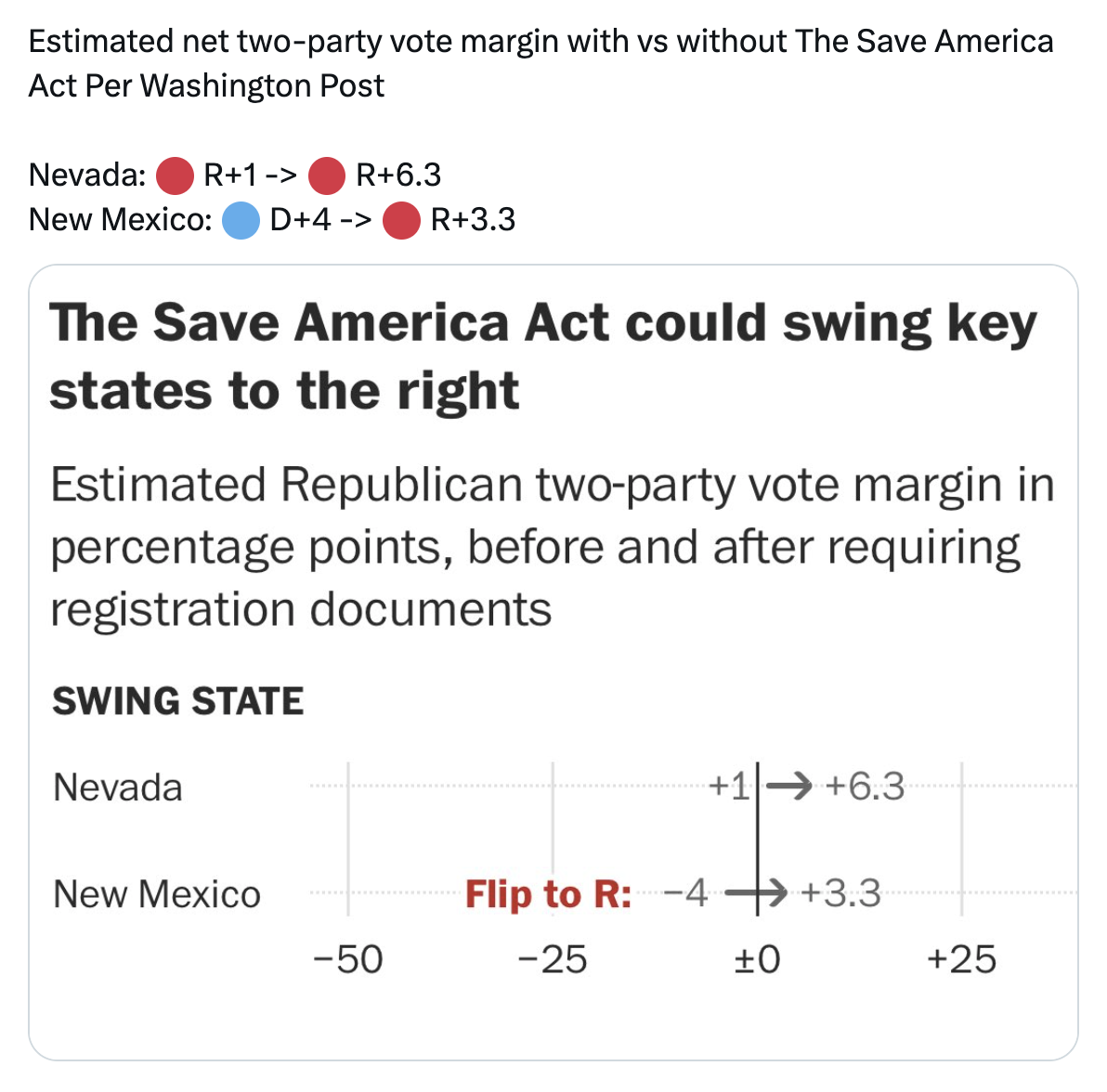
Republicans are making a calculated move to tighten election rules in ways they say will secure the ballot box, and it could reshape the playing field in key Western states like Nevada and New Mexico.
A recent Washington Post opinion by Ian Ayres and Jacob Slaughter argues the SAVE America Act is less about persuasion and more about participation. The proposal, they contend, could tilt close states by changing who is able to register and vote.
The bill is already moving. The House passed the SAVE America Act in a tight 218-213 vote on Feb. 11, 2026. The legislation would require documentary proof of U.S. citizenship to register and mandate photo ID for federal elections. In the Senate, momentum has slowed after a related amendment failed on March 26 in a 53-47 vote.
The focus on Nevada and New Mexico is strategic. Neither state is the largest prize on the map, but both are competitive enough that small shifts in voter participation could carry national implications. In close contests, even modest barriers to registration can have an outsized impact.
Supporters say the measure is a commonsense safeguard to ensure only citizens vote in federal elections. Critics counter that the practical effect would fall on eligible voters who may struggle to produce the required documents, effectively turning election administration into a filter on turnout.
RELATED: House Republicans Take Stand Against Senate Over SAVE Act
The push also extends beyond legislation. The U.S. Department of Justice has been seeking access to unredacted state voter rolls, while federal officials explore linking that data with citizenship records through the Department of Homeland Security’s SAVE verification system. That effort has drawn scrutiny from state officials over transparency and scope.
Taken together, the legislative and administrative tracks point to a broader strategy heading into the 2026 cycle. The SAVE Act represents one front, while federal data enforcement represents another. Both center on tightening registration rules and elevating eligibility checks as a defining campaign issue.
Two key developments could determine what comes next. The first is whether Senate Republicans revive the bill after the failed March vote. The second is whether federal officials succeed in expanding access to state voter data.
If either effort gains traction, Nevada and New Mexico may serve as early indicators of how election rules, not just campaign messaging, can shape the political map.
Download the FREE Trending Politics App to get the latest news FIRST >>