
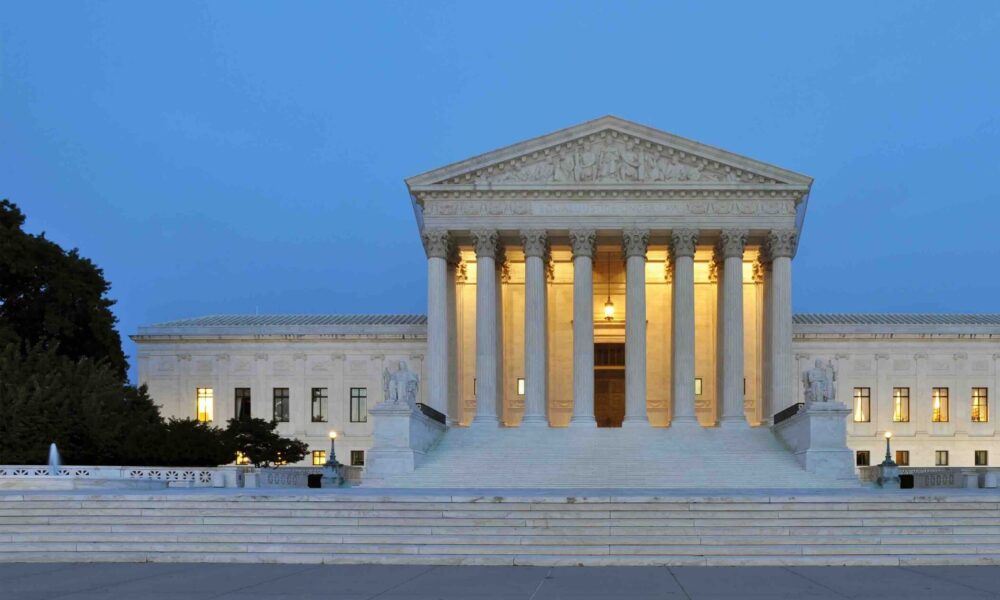
The Supreme Court handed a unanimous win Thursday to a former Twitter employee convicted in a Saudi spying case, ruling that federal prosecutors tried one of his charges in the wrong place.
The decision does not wipe away the broader scandal surrounding Ahmad Abouammo, who was accused of handing confidential information about Saudi dissidents to a high-level Saudi official while working at Twitter.
But it does deliver a clear message to the Justice Department: prosecutors cannot pick a courtroom just because it is convenient.
The case centered on a false invoice Abouammo created while FBI agents were questioning him at his home in Seattle.
At the time, San Francisco-based FBI agents were investigating unauthorized disclosures of Twitter account information. Abouammo had previously worked at Twitter’s San Francisco office, where prosecutors said he provided confidential information about Saudi dissidents using the platform.
In return, a Saudi official wired Abouammo $300,000.
After leaving Twitter and moving to Seattle, Abouammo started a social media consulting business. When FBI agents later questioned him at his home, he denied giving confidential information to the Saudi official and claimed the payments were for consulting work.
When agents asked for proof, Abouammo went upstairs, created a fake invoice and emailed it to one of the agents.
The agents later returned to San Francisco and discovered through the document’s metadata that the invoice had just been created.
Federal prosecutors charged Abouammo in the Northern District of California with falsifying a record to obstruct a federal investigation under 18 U.S.C. §1519.
Abouammo argued that the charge should have been brought in Washington state because that is where he created the fake document.
The government argued California was also proper because the FBI investigation was based there.
The Supreme Court rejected that argument.
In plain English, the court said the crime was the act of falsifying the document. Since that happened in Seattle, that is where the trial on that charge had to take place.
The ruling reversed the 9th Circuit Court of Appeals, which had allowed the California venue because the investigation Abouammo allegedly tried to obstruct was based in San Francisco.
The justices said that stretched the law too far.
“Whatever obstructive effects Abouammo’s false invoice may have had in northern California, they were not elements of his crime and cannot figure in determining where his crime was committed.”
The court explained that the Constitution protects defendants from being dragged into a faraway court when the alleged criminal conduct happened somewhere else.
Article III requires federal criminal trials to be held in the state where the crime was committed, and the Sixth Amendment gives defendants the right to a jury from the state and district where the crime happened.
That venue rule, the court said, is not a technicality. It is a constitutional safeguard dating back to the Founders, who were deeply wary of the government hauling defendants into distant or politically favorable courts.
The justices said the key question is where the defendant’s actual criminal conduct occurred.
For the false document charge, the only conduct the government had to prove was that Abouammo knowingly falsified a document with the intent to obstruct a federal investigation.
Once he created the fake invoice, the crime was complete, the court said. He did not have to send it, use it successfully or actually derail the investigation for the charge to apply.
That meant the location of the FBI office in San Francisco could not be used to justify trying him in California on that count.
The government also argued that the falsification charge was like an unfinished obstruction crime, meaning venue could be tied to the place where the investigation was affected.
The court shot that down, too.
The justices said Section 1519 is its own standalone crime, not an attempt, conspiracy or solicitation offense tied to some separate obstruction charge.
That distinction mattered because prosecutors could not rely on some broader theory of obstruction to move the case into a district where Abouammo did not actually commit the conduct charged.
The ruling is narrow but important.
It does not say Abouammo was innocent. It does not bless what he did. It simply says the federal government must play by the rules when deciding where to put a defendant on trial.
RELATED: Ketanji Brown Jackson Melts Down After New Setback For Democrats At SCOTUS
Abouammo’s case now heads back for further proceedings after the Supreme Court reversed the 9th Circuit’s judgment.
For the Justice Department, the unanimous ruling is a sharp reminder from all nine justices that even ugly cases involving foreign influence and national security concerns do not give prosecutors a free pass to shop for a courtroom.
The bottom line is simple, if the government wants to charge someone with falsifying a document, it has to bring that charge where the document was falsified.
In Abouammo’s case, that place was Seattle, not San Francisco.
Download the FREE Trending Politics App to get the latest news FIRST >>